|
|
|
 |
| |
Tel:086-515-88387638
086-515-88353228
086-515-88353628
Fax:086-515-88353228
Email:info@ychthj.com
Mobile Phone
:
(0)13305101838
Contact:Zhu Taisong |
|
|
 |
 |
|
|
 |
| |
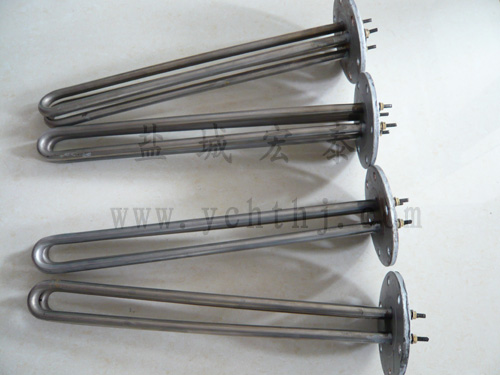
2U Shape Electric Heater |
Detailed parameter |
|
2U Shape Electric Heater
|
Materials & Parameters

|
|
Model |
Applicable Environment & Technique |
Outer Materials of Tube |
Unit Surface Load |
Max. Operating Temp. |
Operating Time |
|
Fluoro-Plastic Electric Heater(CMFLON) |
Suitable for corrosive liquid of strong acid or strong alkali, with the technical temperature of 105℃, no sticking, no dirty, and even heat dissipation on the surface |
PFA/Coating PTFE/Coating |
Stainless Steel, Ti, Iron, Copper 1.5W/C㎡ |
105℃ |
5000-10000h |
|
Ti Electric Heater |
Suitable for processes of chrome plating, copper acidification, nickel plating, passivation, filling, oxidizing tank, anode-polarization of chromic acid, acid tinning, etc |
Ti |
6-4.5W/C㎡ |
140℃ |
5000-10000h |
|
Stainless-Steel Electric Heater |
Suitable for liquid with PH>7-4, oil and other liquids |
304、316L、1Cr18Ni9Ti |
6-4.5W/C㎡ |
150℃ |
5000-10000h |
|
Quartz Electric Heater |
Suitable for anti-corrosive liquid (except hydrofluoric acid) |
Quartz |
1.5W/C㎡ |
200℃ |
5000-10000h |
|
Finned, Dry-Baking-Tubed and Outer-Circled Anti-Blasting Heater |
Suitable for heating in the air, casting and wedging of organ’s mold, and making heating mould organ |
Stainless Steel、1Cr18Ni9Ti 10#Steel |
1-1.2W/C㎡ |
300℃ |
5000-10000h |
|
Remarks |
Type of Coiling Pipe of Electric Heater: U-Typed, W-Typed, I-Typed, L-Typed, Coiling-Typed, Plate-Typed |
| Product Design & Type Selection |
Type Selection Reliance:
1. Inner Sizes of Tank, L * W & H, Height of Liquid Level
2. Technical Temperature, Beginning Temperature, Ending Temperature
3. Warming-up or Cooling-Down Time (h)
Heat Exchanging Capacity (Warming-up, Cooling-down):
Q=V×C×r×β(t2-t1)/T(千卡)
Q=V×C×r×β(t2-t1)/T(Kcal)
V: Solution Volume (L)
C: Solution Specific Heat (Kcal/Liter×℃)
r: Proportion (Km/L)
t1: Solution’s Beginning Temperature
t2: Solution’s Ending Temperature
β: Heat Loss Coefficient (1.10—1.30)
If Q is positive, it would be the required volume for warming-up.
If Q is negative, it would be the required volume for cooling-down.
T: Warming-up or Pre-Cooling Time (h)
Electrical Thermal Equivalent (Dielectric Heat):
Q=0.864×I×V(Kcal/h)
I: Total Current A V: Tank Voltage V
Heat Exchanging Area of Heat Exchanger (S):
S=Q/K×ΔT×t
Q: Heat Exchanging Volume (Kcal)
K: Thermal Transmission Coefficient kcal/m2×hr×℃ (Referring to the Thermal Transmission Coefficient List V)
V: Solution Volume (L)
ΔT: Average Temperature Difference
t: Set Heating (Cooling) Time (h)
Type Selection
The heat exchanging area of the heat exchanger could be confirmed after calculation. The number of the group and the shape of the heat exchanger would be determined by the sizes of the tank (the reaction kettle). Usually, “U”, “W” and “L” coiling pipes are selected. For heating, the heat exchanger is at the bottom of the container. For cooling, the heat exchanger is 100mm lower than the liquid level. We could assist the clients to select the type and supply the design alternatives. |
Notes:
1. The organ could work under the following conditions:
(1) The air’s relative humidity is no more than 95%;
(2) The operating voltage should be no more than 1.1 times of the rated value. The outer shell should be with the valid grounding.
2. If the heating media is the liquid, the valid height of the organ (H1 or H2) should be completely soaked in the liquid. Usually, the distance between the heating part and the well of the container should be more than 50-60mm.
3. The organ for heating the liquid could not be used to heat the gas or the solid.
4. For the organ to heat the liquid, if there’s the sediment on the surface of the pipe, it should be cleaned off so as to guarantee the service life and the thermal efficiency.
5. If the organ is used to heat the light metal and the solid including saltpeter salt, alkali, bitumen, wax, etc, it’s necessary to start up the voltage-decreasing procedure, and then increase to the rated voltage after the solid heating media is completely melt.
6. When heating the saltpeter salt, it’s required to take the safety measures, so as to avoid any blasting.
7. The wiring of the organ would be in the insulation layer and out of the heating room, as well as being kept from the corrosive or explosive gas. In addition, it’s also required to keep the out-thread end dry and clean, so as to avoid any falshover or short circuit. Please be careful for wiring.
9. There would be little mash overflowed from the end of the organ. It’s the sealing material, which would not influence the normal using. It’s enough to clean it after powerdown.
10. The organ should be stored in the room where the relative humidity is no more than 85%, the air is ventilated and there’s no corrosive gas.
11. If the organ is wetting and not been used for long term after being used, with the cold-state insulation resistance less than 1 megohm, it’s advised to bake the organ on the drying cabinet at around 200℃, or to decrease the voltage and switch on the power supply to heat directly. | |
|
|
|
|